The “Industry Secret” Most ITIL Training Providers Won’t Tell You, But we will!
Most Accredited Training Organizations (ATOs) are licensed to deliver the exact same official PeopleCert courseware. This means across the industry:
- The slides are identical between providers.
- The structure is identical between providers.
- The sequencing is identical between providers.
Unless, they submit it for reaccreditation with their changes, which rarely happens.
In many cases, even the trainers are the same. The global pool of certified, high-level specialists is small. The same expert may appear in proposals from three different companies; only the logo on the contract changes.
The Commercial Reality of the Trainer
There is a massive gap in the market. A high-tier IT consultant commands $2,000+/day. A standard trainer often commands $650–$1,200/day.
Because of this, training roles usually attract three types:
- Career Educators: Passionate about teaching.
- Practitioners: Who balance real-world consulting with facilitation.
- The “Newly Certified”: Lower-paid, building experience at the expense of your learning quality.
The “Level Playing Field” Trap
PeopleCert supplies standardized base courseware to ensure consistency and compliance. On paper, this creates a “level playing field.”
In reality, it creates a commodity. If the core content is identical, providers stop competing on education and start competing on commercials: branding, aggressive sales tactics, and price-cutting.
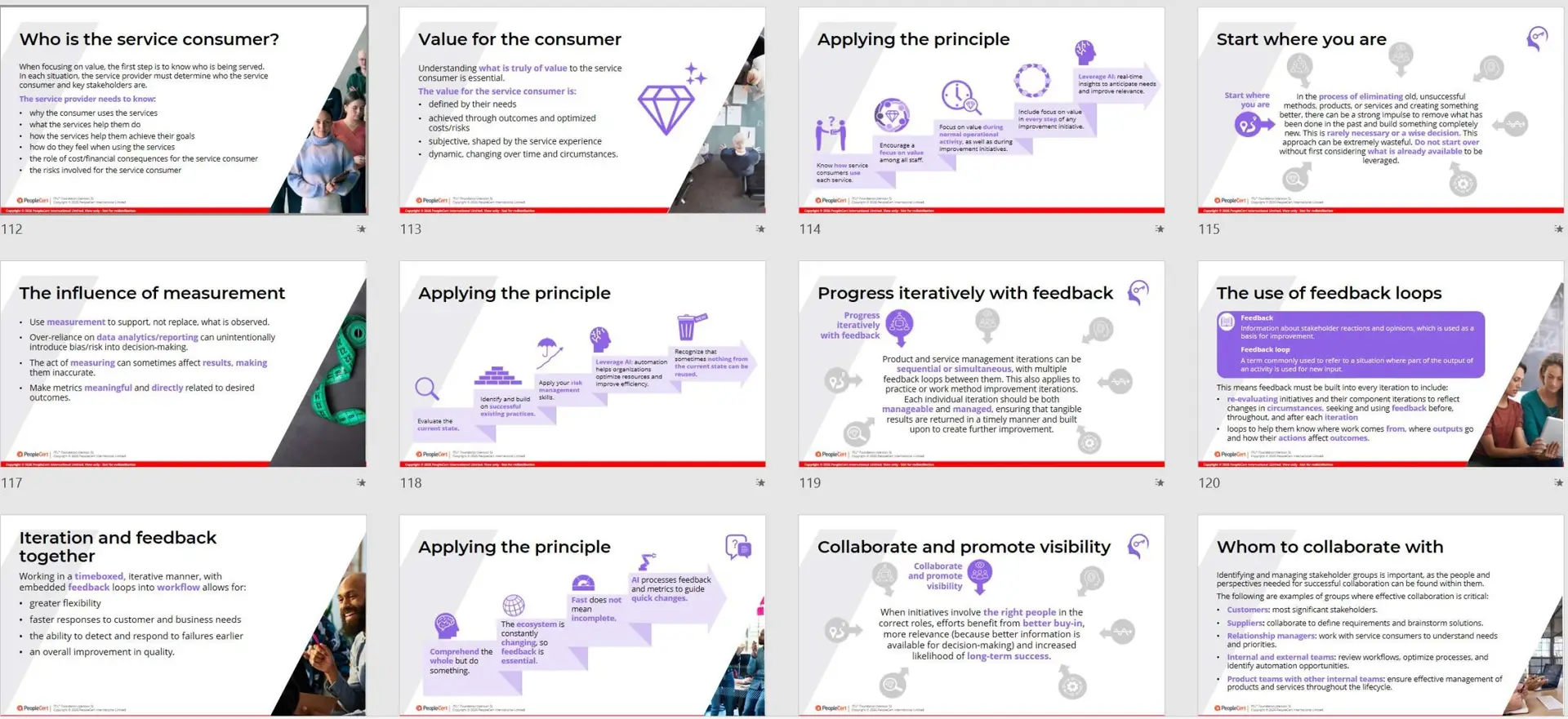
The underlying material remains dry, text-heavy, and repetitive (usually a sea of purple slides).
Foundation vs. Enhancement: Which are you buying?
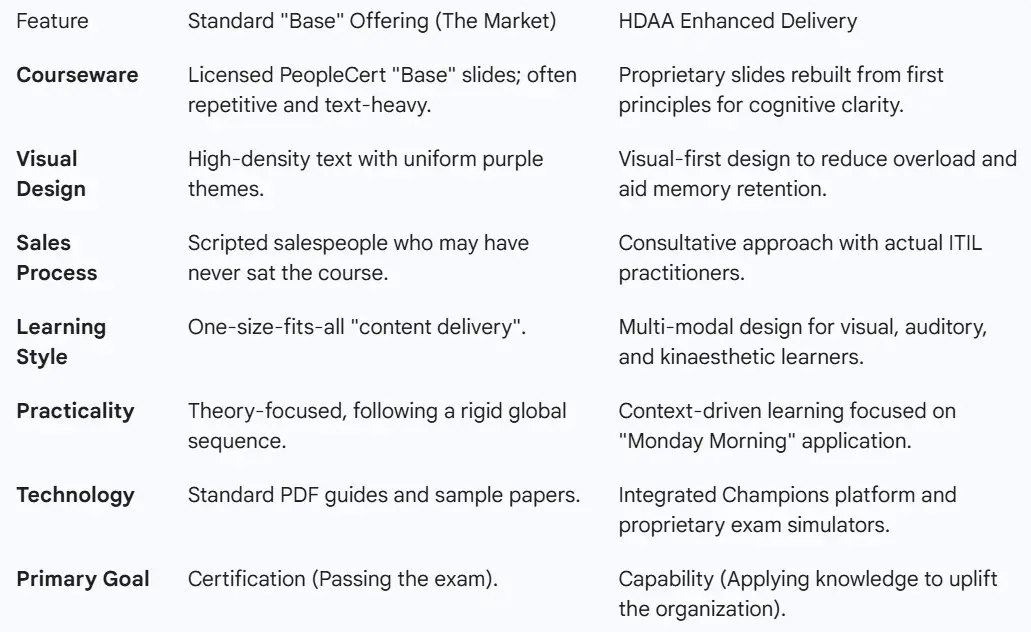
Most providers deliver the licensed material “as-is.” At HDAA, we made a strategic decision years ago: The baseline is not enough.
We don’t just “repackage” the framework; we interpret and apply it. While others deliver a “stack of slides,” we invest in building a capability engine:
- Cognitive Load Reduction: We strip the “wall of text” slides and rebuild them for clarity.
- The Champions Platform: Integrating our proprietary exam simulators and learning software.
- Multi-Modal Learning: Designing for visual, auditory, and kinesthetic learners, not just those who can read a screen for 8 hours.
- Contextual Translation: Turning “ITIL Theory” into “Monday Morning Application.”
The “Hamburger” Analogy
Buying a standard “McTraining” ITIL course is like visiting three different restaurants that all serve the same pre-made, frozen hamburger from the same supplier.
- Provider A puts it in a fancy box.
- Provider B sells it cheaper.
- Provider C has a better website.
But the ingredients haven’t changed. You’re often paying a premium for a “McTraining” course based on a salesperson’s “schpeel.” The Reality Check: Most training salespeople have never sat an ITIL course, let alone practiced it. They are reading from a script, selling a product they don’t fundamentally understand.
At HDAA, we aren’t just changing the wrapper; we’re in the kitchen cooking from first principles.
We don’t even have a sales team. When you call us, you don’t speak to a “hired gun” with a quota; you speak to an ITIL Practitioner.
You get expertise from the first hello, not a sales pitch.
The “Before You Enroll” Checklist
Stop asking if a provider is accredited (that’s the bare minimum). Start asking these:
- Who am I talking to right now? Are you a scripted salesperson with a quota, or an ITIL practitioner who has actually implemented these frameworks?
- Are you using the official “base” slide deck, or your own developed courseware? Can I see a sample slide from Module 2 or 3? (Look for the “Sea of Purple” vs. custom design).
- How do you cater to different learning styles? If the answer is “the trainer explains it,” they aren’t designing for multi-modal learning.
- What exam preparation tools do you provide beyond a sample paper? Do you have an integrated simulator or a dedicated learning platform like HDAA’s Champions?
- How do you translate theory into real-world context? Ask for a specific example of how they teach Value Streams or Service Level Management.
- How experienced, and exclusive, is the trainer? Is this a “hired gun” freelancer you found for this week, or a long-term member of your expert team? Can you tell me their name? (then look up their profile on Linked in)
- What happens if I struggle with the exam? Is there a safety net, or are you just a number in a system?
- How long have you been refining your specific delivery method? Accreditation is a starting line. What have you done with the content since you got it?
The Bottom Line
Accreditation is essential. Enhancement is optional.And in this industry, “optional investment” is the only true signal of a provider’s intent.
Do you want content delivered, or capability developed?
Why the visual difference matters
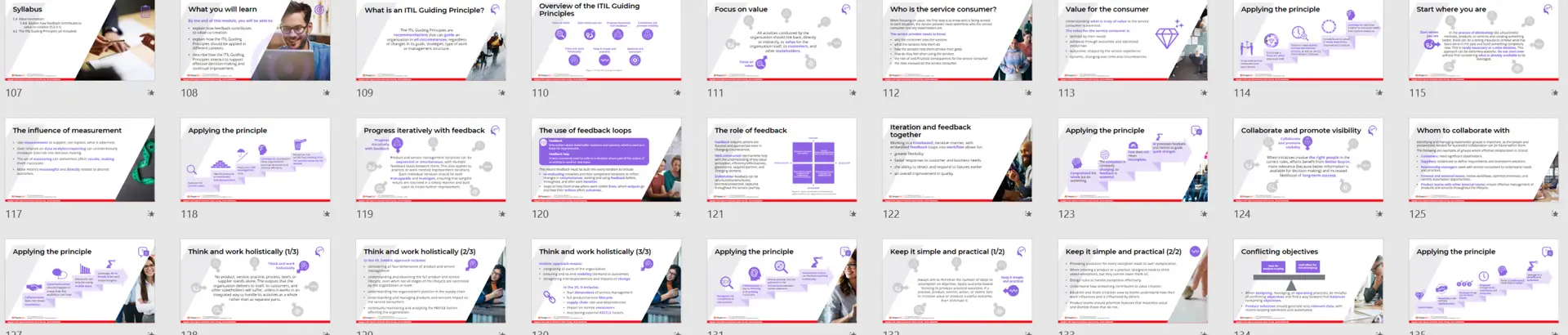
When you look at the Standard Slide Example, you see a repetitive structure designed for neutrality. This course is 2-3 days long, paying attention to the same layout and colors for 8 hours a day, you will switch of quickly and not retain information. Zoomed out, you can see a lot of these slides from the Base slide deck look almost the same.
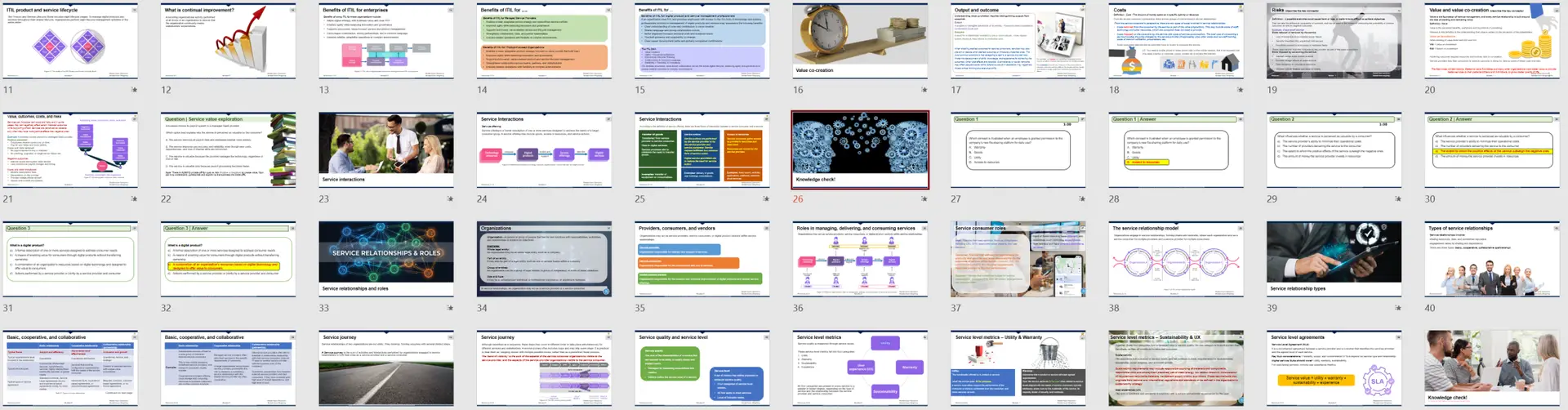
When you look at the HDAA Example, you see a deliberate shift toward diagrams, real-world imagery, and varied layouts.
At HDAA, we replace passive ‘content delivery’ with Multi-Modal Instructional Design, using strategic pattern interrupts and sensory cues to transform dry theory into an active, high-retention learning experience.
This isn’t just about “looking better”, it’s about how your brain processes information. A wall of purple text is a recipe for “zoning out.” A dynamic, practitioner-led visual helps you internalize the framework so you can actually use it when you get back to the office.
A PDF certificate says “Yay, I passed.” But uplifted capability actually makes your money work for you by streamlining value chains and increasing efficiency long after the exam is over.
Don’t just buy the slides. Buy the result.
About the Author: Scott Tunn is the Managing Director and CEO of HDAA, the independent industry body for Service and Support professionals across Australasia. A practitioner at heart, Scott specializes in Digital Transformation, Process Engineering, and Data-Driven Decision Making. He is a leading advocate for moving the training industry away from passive “content delivery” toward high-retention learning, an approach that prioritizes real-world capability and organizational uplift over mere certification.
Who is HDAA?
HDAA is the independent industry body dedicated to powering the Service and Support Profession across Australasia. For over 20 years, we have been the primary source of collaboration and knowledge for IT Support, Enterprise Support, and Shared Services professionals.
Why We Exist
We exist to move the industry from “content delivery” to “capability development.” We believe that a certification body should do more than just hand out certificates; it should provide the tools, research, and real-world practitioner expertise to help organizations work smarter, not harder. Our mission is to promote excellence through education and to support you in supporting others.
How to Join the Community
Whether you are an individual looking to elevate your career or an organization seeking a strategic edge, there is a place for you at HDAA.
- Become a Member: Gain unrestricted access to our Knowledge Base, exclusive industry reports, and significant discounts on all training and consulting.
- Buy Our Training: Experience our Multi-Modal Instructional Design first-hand. We offer instructor-led, practitioner-designed courses in ITIL 4, HDI, and Major Incident Management.
- Get in Touch: Skip the sales “schpeel” and speak directly with a fellow practitioner.


