
Member Only Article
I once worked with a Service Desk Manager named Sarah who was, quite frankly, drowning. Every Tuesday morning, like clockwork, her team would get hit with 40+ tickets about a specific enterprise reporting tool. The error was always the same. The fix was always a manual database refresh that took twenty minutes of an analyst’s time.
Sarah did everything right by the “old” book. She optimized the workflow. She created a Knowledge Base article. She even automated the refresh script. But the tickets kept coming. When she finally walked over to the Product Development floor to ask when the bug would be fixed, the Lead Developer looked at her like she was speaking Klingon. “We’re not working on that,” he said. “We’re halfway through building the next-gen reporting module. We don’t have time for legacy bugs.”
That is the sound of a value loop snapping in half.
The Support team was managing a service, while the Development team was building a product. In the old world of ITIL 4, we focused heavily on these as distinct practices. In the world of ITIL 5, that wall has been torn down. We are no longer just “fixing things”; we are providing the raw intelligence that dictates what the business builds next.
The Problem: When Service is a Cul-de-Sac
For years, the Service Desk has been treated as a cost center: a place where value goes to be “restored” but rarely “created.” We talk about Mean Time to Repair (MTTR) and First Contact Resolution (FCR). These are great metrics for keeping the lights on, but they are defensive.
When your service data: the thousands of interactions, frustrations, and “how-to” questions: stays trapped inside a ticketing system, it becomes a cul-de-sac. The product team continues to Acquire and Build based on theoretical requirements or “market trends,” completely oblivious to the lived reality of the user.
The result? You launch a “Next Gen” product that carries over 80% of the friction from the previous version because nobody bothered to check the service logs.
ITIL 5 vs ITIL 4: Key Differences for Service Desk Managers
If you are transitioning from ITIL 4, you might be wondering why we need another framework. The reality is that the pace of digital delivery has outstripped the “practice-based” approach.
One of the itil 5 vs itil 4: key differences for service desk managers is the shift from a linear Service Value Chain to an integrated Product-Service Lifecycle. ITIL 4 introduced the idea of “Value Streams,” which was a massive leap forward. However, ITIL 5 goes deeper into the integration of the Support and Deliver phases directly into the Acquire and Build phases.
In ITIL 5, the Service Desk is the “Sensor Array” for the entire organization. We aren’t just resolving incidents; we are identifying Value Leakage. If a user can’t figure out how to use a feature, that is a design failure, not a training issue. If a component fails three times a month, that is a procurement or build issue.

The Infinite Loop: Bridging ‘Support’ and ‘Build’
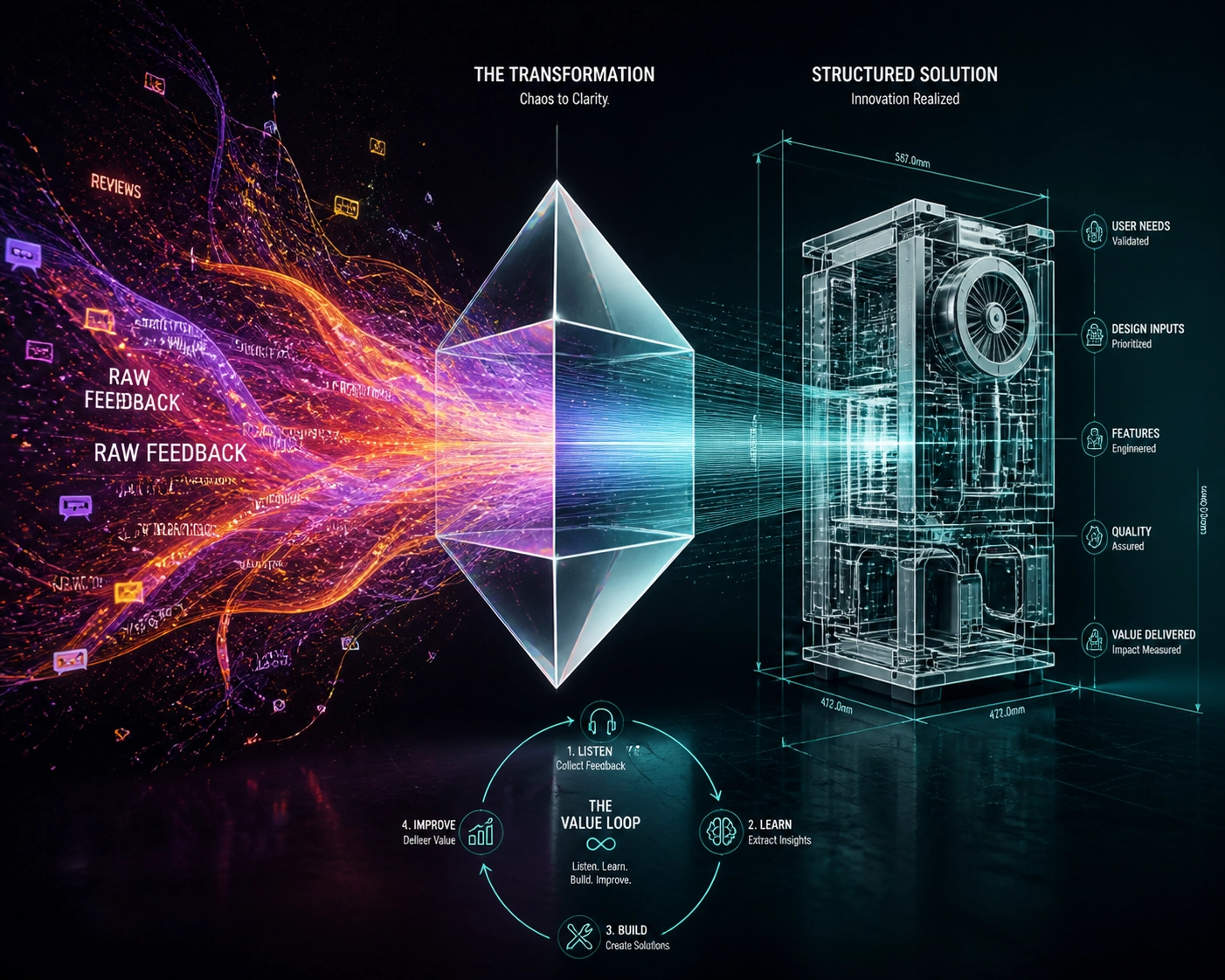
To close the value loop, we have to treat service data as a strategic asset. This isn’t about sending a monthly “Top 10 Issues” report to a developer who will promptly ignore it. It’s about a systematic flow where service outcomes trigger product actions.
1. Data Capture (The Sensor Phase)
Everything starts with how you categorize your work. If your incident categories are “Hardware,” “Software,” and “Network,” you are failing. You need to link service events to specific product versions, components, and even user personas.
When Sarah (from our story) finally started tagging those reporting tickets not just as “Software Error,” but as “Product: Reporting Tool | Component: DB-Sync | Phase: Usage Friction,” she had data that a Product Owner could actually use.
2. The Problem Management Process as a Catalyst
This is where the problem management process evolves. In traditional ITSM, problem management was about finding the “root cause” to stop the bleeding. In the ITIL 5 architect-level mindset, problem management is a research and development (R&D) function.
Instead of just asking “Why did this break?”, we ask:
- “What is the economic cost of this recurring friction?”
- “Does this represent a fundamental flaw in our current ‘Build’ logic?”
- “Should we stop the ‘Acquire’ phase of a new tool until this is resolved?”
3. Translation and Prioritization
Product Managers speak the language of “Features” and “Epics.” Service Managers speak the language of “Incidents” and “SLA.” To close the loop, you must translate service pain into product currency.
If you tell a Product Owner, “We have too many tickets,” they might feel bad for you, but they won’t change their roadmap. If you tell them, “The current design of the login screen is costing us $14,000 a month in wasted Service Desk labor and has a 12% correlation with customer churn,” you have their undivided attention.
How Service Data Triggers the Next Lifecycle
When the loop is closed, the “Support and Deliver” phase doesn’t just sit at the end of the line. It loops back to the very beginning of the next product iteration.
- Refining Requirements: Real-world usage data tells you what features people actually use. If 60% of your product is “Shelfware” (never touched), the next Build phase should focus on stripping complexity, not adding it.
- Improving Reliability: Service data identifies the “fragile” parts of the architecture. This informs the Acquire phase: perhaps you need a different vendor or a more robust cloud provider.
- Validating Value: The ultimate goal of ITIL 5 is to prove that the value promised during the design phase was actually realized in the hands of the user. If the NPS is low despite the product being “bug-free,” the loop tells you that you built the wrong thing.
Building Your Own Value Loop: A 3-Step Action Plan
You don’t need a massive budget to start this. You need a shift in perspective.
Step 1: Audit Your Feedback Channels
Stop relying solely on CSAT. CSAT tells you how the agent performed, not how the product performed. Look at your “How-To” ticket volume. High “How-To” volume is a red flag for poor product design.
Step 2: Embed Service in the “Build” Phase
If your organization is building a new service or product, demand a seat at the table. Not as a “tester,” but as an advisor on “Supportability.” If the product isn’t designed to be supported, it shouldn’t be built.
Step 3: Update Your Skills
The transition from a “Service Manager” to a “Value Stream Architect” requires a new set of tools. Understanding how ITIL 5 integrates these concepts is the “price of admission” for the next decade of IT leadership.
At HDAA, we’ve seen hundreds of organizations make this pivot. It’s the difference between a Service Desk that feels like a “treadmill” and one that feels like an “engine room.”
Closing the Circle
The days of “throwing it over the wall” are over. Whether you are a Service Desk Manager, a Product Owner, or a CIO, your success depends on how quickly you can turn service feedback into product improvement.
Sarah eventually got that reporting tool fixed. Not by asking nicely, but by proving that the “manual refresh” was the single biggest blocker to the company’s new data-driven strategy. She stopped being the person who fixed the tool and became the person who perfected the product.
That’s the power of the Value Loop.
Ready to Lead the Transition?
The shift from ITIL 4 to ITIL 5 isn’t just about new terminology: it’s about a fundamental change in how we deliver value in a product-centric world. If you’re ready to move beyond basic ticket management and start architecting true value loops, we can help.
- Get the Foundations Right: Explore our [HDAA ITIL 5 Foundation Course](https://hdaa.com.au/itil-5-foundation-course/ to understand the core mechanics of the new framework.
- Level Up Your Strategy: For those ready to lead the charge, our [Intermediate and Architect-level courses](https://hdaa.com.au/training-catalogue/ provide the deep-dive integration skills needed to bridge the gap between Product and Service.
Check our current HDAA Training Calendar for upcoming sessions and certification tracks.
Don’t just support the business. Shape it.
Assessment Criteria Tags:
#ITIL5 #ValueLoop #ProductLifecycle #ServiceManagement #ITSM #ProblemManagement #ServiceDeskManager #HDAA #DigitalTransformation #ValueStreamMapping